Trust issues

Standard

I’ve been working on a scene in my book that is a pivotal moment for my main character. I’m not actually that far along in the story yet, but I really wanted to write it so I skipped ahead. The difficulty in writing the scene was the need for Rosaline to decide if she trusts someone or not, and I needed to decide if her decision is the correct one. My choice and hers could bring the story in different directions and I had to weigh the pros and cons of each. An added concern was that the choices revolved around a real life event, so the characters’ actions had to make sense for the real outcome.

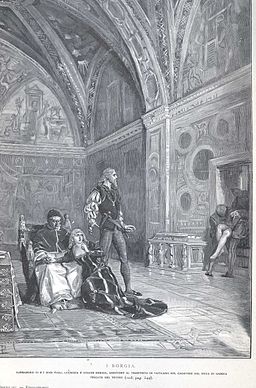
On June 14, 1497, after leaving a family dinner at his mother’s home, Juan Borgia was murdered and his body dumped in the Tiber in Rome. The Pope began an investigation, but abruptly called it off after only a few days. As a result, while the family had many enemies, a rumour implicating his brother Cesare began to circulate. Juan’s murder was never solved.

Borgia

See page for author [Public domain], via Wikimedia Commons

At this point in my story, Rosaline is close to the Borgia family, acting as Lucrezia’s confidante and friend and frequently sparing with Cesare, though they are also friends. It is a dangerous time and Rosaline needs to decide what path she wishes to follow.

While the process was difficult and I struggled to make a final choice for the plot, I really enjoyed writing it and, ultimately, I think I stayed true to Rosaline’s character and her development.

Now I have to go back and tie the sections of my story together. Knowing where the characters are going and what the fall out will be helps me weave details and clues in the previous pages. I have to admit, the hard work of putting together feels really satisfying.

BJL

Tweeting while Reading

Standard

Who says reading has to be a solitary activity? I’ve decided to live tweet my reading of Come, Thou Tortoise by Jessica Grant. I started reading it last night so follow me on Twitter @rereadpages to catch up and to see updates as I continue reading (#comethoutortoise).

Come Thou Tortoise

And please tweet your thoughts back at me. I’d love to read them!

#tbt book nerd style

Standard

Last week in celebration of International Children’s Book Day, I discussed The Seventh Princess, which is the first book I remember buying for myself, check that post out here. I enjoyed my book nostalgia so much that I’ve decided to make #tbt book nerd style a regular feature on re: read pages.

This week as part of National Poetry Month, I want to bring to your attention the first collection of poems that really made an impact on me. I had read individual poems that made an immediate impact, perhaps by the usual suspects – Robert Frost’s Stopping by Woods on a Snowy Evening, Wilfred Owen’s Dulce et Decorum Est – but the collection Execution Poems by George Elliott Clarke lingered with me in a way I hadn’t previously experienced.

The collection, which won the Governor General’s Award for poetry in 2001, addresses the real story of Clarke’s cousins, two black men who were convicted of murder and hanged in New Brunswick in 1949. Just the idea that they were hanged so recently, which seems archaic, stuck with me, but the poems also use the experience of George and Rufus Hamilton to a reflect on the effects of systemic racism and cyclical poverty – issues that still need thoughtful contemplation.

Yesterday, as I reread these poems, one line stood out from the first page and I will leave you with those words:

My black face must preface murder for you.

Things that make you go hmmm

Standard

I feel like I’ve read a series of books in which important plot points defy the laws of coincidence. Meaning that an event occurs or a detail is revealed that makes me say hmmm? It’s too neat or too unlikely and I am incapable of truly accepting the information no matter how great its impact.

Longbourn by Jo Baker is, unfortunately, full of such moments. Subtitled, Pride and Prejudice: The Servants’ Story, the novel tells about the hidden lives of the servants in Jane Austen’s beloved tale.

The details of the work, how the lives of the Bennet girls impact their day, is well done. Notes of tea leaves sprinkled to clean floors, lye burning their hands as they scrub dress hems clean, or recycling washing water to clean the flagstone outside are neatly incorporated. In one passage Sarah, the housemaid at the centre of this novel, feels as though her job has seeped into her very skin:

She lifted her hands to sniff them: grease and onions and kitchen soap. This must be the smell she carried with her wherever she went, whenever it was not something worse.

Sarah is aware of herself and how she is seen or, more accurately,  not seen by her employers. The servants presence and work are both taken for granted and ignored by the Bennet girls, but Baker does a good job of showing how the servants’ fears about their future are as equal to Mrs. Bennet’s and her girls. Baker falters when describing the lives the servants try to make for themselves outside of work, making choices that seem out of touch for the time period and forced for dramatic purposes.

The love life of the characters is the best example. The servants from the various households interact as the Bennet daughters are courted. A footman from the Bingley household is eager to make an impression on Sarah – but Ptolemy is not just a footman with grand ideas for his future (he wants to open a tobacco shop), he is a black footman.

Why Baker felt the need to include this twist is beyond me. Pride and Prejudice is set in the early 1800s, which means the slave trade (but not slavery itself) had only just been outlawed. The likelihood of an upper class, original old-money family having a black footman seems impossible, especially in a position that, if Downton Abbey has taught me anything, requires some training.

But Baker doesn’t stop there. I went from hmmm to whatever when the housekeeper, Mrs. Hill, started looking to Ptolemy as a potential husband for Sarah. I know the rules were different for the servant class, but I’m pretty sure mixed-marriage was off the books for a long time coming. And the reason Mrs. Hill was even looking to Ptolemy for Sarah was the sudden absence of the housemaid’s suitor, the sometimes footman and general labourer at Longbourn, James Smith.

The Bennet women forget that James was even a part of their lives. They even forget his name. His importance is secondary to the pursuit of marriage for the Bennett daughters. The strain of his disappearance pulls at the household as Lydia has run off with Wickham.

I admit I enjoyed that his name could be anybody’s. Even today, James Smith would turn up a lot of Google hits. The blandness of his name makes people think he is a nobody, but to Sarah, to Mrs. Hill, to the people who love him – he is irreplaceable.

Smith’s story is also somewhat of a misstep, in my opinion. Baker fills out his back story from a rough sketch of his childhood through the rough years of living as a solider in the Peninsular War to just as he joins the Bennet household. His story is interesting and well told but it also takes you far away from Longbourn. The twist in his history (another thing to make me go hmmm) and his connection to Longbourn don’t really make up for the amount of time spent away from Sarah and the storyline provided by Pride and Prejudice.

The time taken for Smith’s story is especially frustrating after Sarah decides to quit her job with the newly married Elizabeth to find the long absent Smith after she gets an idea of where to find him. Sarah’s journey north, on foot, on her own is completely skipped over and the story picks up when the two lovers are reunited. The story flashes forward again to wrap up with the two of them arriving back home to Longbourn.

This isn’t to say that I didn’t enjoy Longbourn or that Baker isn’t an accomplished writer, just that I couldn’t lose myself in this story.

#tbt book nerd style

Standard

Today is International Children’s Book Day and it is a (throwback) Thursday, so I thought I would mark the occasion with a post about a book I read as a child.

I bought The Seventh Princess by Nick Sullivan at a Scholastic book fair at my elementary school. Do you remember having book fairs at your school? I loved them. All the books lined up on tables. Getting a little money from my parents to pick out a book for myself. It was so exciting.

The Seventh Princess by Nick Sullivan (1983)

I’ve kept it all these years because of the memory of getting to buy it for myself and for the pleasure of the story. The Seventh Princess tells the story of Jennifer, a young girl who is transported off her school bus to a strange land where everyone thinks she is a princess. But, as Jennifer learns, being a princess in this place is no fairy tale and she will soon be turned into a harpy, doomed to do the bidding of the powerful sorceress Swenhild. With the help of some new friends, Jennifer must break the spell and free the kingdom and the princesses from Swenhild’s grasp.

I was really into fantasy at the time and I loved the cover – I still do, something about the blue of her cloak and the town in the background. So The Seventh Princess still sits on my shelf, waiting for my kids to get old enough to enjoy it.

Do you have any books that you’ve held on to from your childhood?

All work and no reading make me something something

Standard

I spend the winter sitting by a desk only going outside when the sun hasn’t risen or has already set. Every year I think I know what I am getting in to but somehow I find myself surprised by my lack of time.

This year was no different. I started off strong. I used my commute to read and to send emails to family and friends in an attempt to maintain the resemblance of a normal life. I think that lasted two weeks. Then my book just turned into another object I hauled back and forth between home and the office and emails to friends turned into emails for work.

But now it is spring. Now is the time to crack the spine of a new book. Now is the time to sit by the lake and plot the next chapter in my novel. Now is the time newness and growth.

I already have a couple books lined up to read.Come Thou Tortoise

First up is Come, Thou Tortoise by Jessica Grant. This novel is the first I am reading as part of a book club that I joined through my local library. It is Grant’s debut novel and sounds delightfully unusual as one of the narrators is a 300-year-old tortoise.

I also have David Adams Richards’ Road to the Stilt House (1985) in my to-read pile for April. I’m excited to get back to Richards’ novels, though this has been called his darkest novel so I am preparing myself for a challenging read.

As for my novel, I have no specific goal except to write every chance I get and to work to give myself those chances. To that end, I’ve given up all but one of the time-sucking websites I use to frequent, which has already opened up so much more time in my day, and I’ve made good use of the focus view on Word – the extra step to look online makes me think twice about random browsing.

Spring is a hopeful time for me. My hope for this spring is to read a few good books and write a few memorable lines.

I’ve also made the leap to Twitter, so I hope I get to chat with more people about reading, writing, and all things books. Find me @rereadpages.

BJL

Realistic to Reality

Standard

I didn’t finish my novel in 2014. When I started my blog I really thought it would be a possibility. I would get my first draft done. When I look back at my posts over the year, I can see where my job, you know, interfered with my writing – there are several months when I have no posts and completed no writing of any kind. And then there are posts that are full of great plans that never got fulfilled. I admit I felt embarrassed and discouraged by my inability to reach my goals and my general lack of progress. Even at the beginning of this year, when I sat down and looked at my novel, I had to work hard to not just give up entirely – on the blog and on my novel.

But then I read a really good book called Juliet’s Nurse by Lois Leveen. I wrote about it in a guest post on Girl of 1000 Wonders, check it out here, but as you can probably guess, it is about the Nurse from Shakespeare’s Romeo and Juliet. The novel is a good example of historical adaptation: it uses the source material well, smoothly integrates historical details, and presents a good original story. And it made me rethink my own novel.

What I was left with at the end of Juliet’s Nurse was not only a satisfying reading experience but also a renewed sense of value to my own story. Rosaline’s story is worth telling.

So now I need to make a plan to which I can actually stick. Part of that will be admitting that, as my busy season at my work starts up in the next week, I won’t be doing much, if any, writing. And that’s okay. It’s not because I don’t believe in my story or want to get it done, but that I am just giving way to the reality of my situation.

Would I still like to finish my first draft this year? You bet. But I will just have to deal with the pace my life allows me. I have to take the time I am given and use it well. I have to turn off the distractions (cough, cough, Netflix, cough). I have to remember the hard work does pay off. I have to put words on the page and not try write the next great Canadian novel but write my novel.

Step one: break one bad writing habit.

I will write every day. It doesn’t even have to be on my novel, but I will sit down and write. Even if I can only find five minutes, it is better than nothing. Those minutes and words will add up to pages, chapters and, eventually, a book.

Today I wrote 206 words for my novel. Huzzah!

BJL

Be Our Guest

Standard

Today, I am guest blogging on Girl of 1000 Wonders. Thanks, Charlie, for letting me be a part of your book discussion!

So go check out my post, Another Side to the Story, on the novel Juliet’s Nurse by Lois Leveen. As is obvious from the title, it tells the story of the Nurse from Romeo and Juliet, starting on the day that Juliet is born. Leveen does a great job of creating a history and rounded character for Shakespeare’s bawdy nurse.

And be sure to check back here at re: read pages later this week for an update on my writing plans and my thoughts on Jo Baker’s Longbourn.

BJL

New year, new post

Standard

Happy New Year!

Welcome back to re: read pages, the blog that looks for books worth rereading and discusses the art of writing all while forcing me to keep working on my own first novel.

I hope you all had a fun and festive holiday season. Since we are now in a new year, I have made some resolutions about re: read pages that I would like to share with you.

  • Writing for my novel has priority over writing for my blog – I lost a lot of good writing time by trying to maintain the quality and quantity of this blog. While I really enjoyed all that I did on re: read pages, it didn’t help me with my ultimate goal of finishing my novel.
  • It is important that I post, not when I post – while I will make every attempt to post two times a week, on Wednesdays and Fridays, I will not hold on to an idea just to match up to my intended blogging schedule.
  • Have more fun – as I have in other areas of my life, I took things a little too seriously when writing for re: read pages. Reading is fun and this blog so should be as well.

That’s it for me for now. Do you have any reading or writing resolutions for 2015? Sound off in the comments below and happy reading.

BJL

2014 in review

Standard

Looking back is always part of New Year’s Eve, and looking back over a year of re: read pages gives me a lot of joy. I hope you found some great new authors or books worth rereading as a result of perusing this blog. Thanks so much for checking in. I hope to bring more discussion, reviews and writing updates in the year to come.

Check out the year in review for re: read pages from WordPress.

Happy reading in 2015!

Here’s an excerpt:

A San Francisco cable car holds 60 people. This blog was viewed about 990 times in 2014. If it were a cable car, it would take about 17 trips to carry that many people.

Click here to see the complete report.
