When love speaks

Standard

I don’t remember my wedding vows. My husband and I wrote them together, and we stumbled through them together on our wedding day – nine years ago today. But unless I managed to find a working cassette player and listened to the recording again, I would not be able to tell you what they included. Something about love and respect, I’m sure.

But what I do remember is the reading we selected for the ceremony, which, thanks to Rufus Wainwright, we also danced to for our first dance.

Shakespeare’s Sonnet 29

When in disgrace with Fortune and men’s eyes,

I all alone beweep my outcast state,

And trouble deaf heaven with my bootless cries,

And look upon myself and curse my fate,

Wishing me like to one more rich in hope,

Featured like him, like him with friends possess’d,

Desiring this man’s art, and that man’s scope,

With what I most enjoy contented least.

Yet in these thoughts myself almost despising,

Haply I think on thee, and then my state,

Like to the lark at break of day arising

From sullen earth, sings hymns at heaven’s gate;

For thy sweet love remember’d such wealth brings

That then I scorn to change my state with kings.

These words have held me up, held us up, through the best and worst moments. They remind me when I feel worthless that someone values me more than anything else in the world. They remind him that I love him as he is not as he expected to be to others. They remind us that just because we own less than some people doesn’t mean we have less.

These words bring us back to the moment we first said I love you, to the moment we said I do, and to each moment when we chose to stay side by side.

Happy anniversary, Sweet Pea.

Love by the book: Part One

Standard

I use to devour romance novels. Short, easy to read, page-turning plots: what’s not to love about books about love? Nora Roberts, the reigning queen of hearts, has published over 200 novels. She also publishes under the pseudonym J.D. Robb, which was created just to keep up with her output. By her own estimation, Roberts finishes a new novel every 45 days. What?!? You can argue about the quality (and we will), but you can’t deny that she still puts words on the page at a phenomenal rate.

Given her success and influence in the romance genre, I thought it would be an interesting comparison to read her first romance novel and one that was recently published.

Her first, Irish Thoroughbred, was published in 1981 with Silhouette Books. Irish Thoroughbred tells the story of Adelia Cunane who moves to America to live with her uncle and winds up training champion horses and falling in love with Travis Grant, the owner of Royal Meadows stables.

For comparison I chose Dark Witch, published in November 2013 with Berkley Books, though it isn’t the most recent as there were three other books published after this date. Dark Witch tells the story of Iona Sheehan who moves from the U.S. to live in Ireland with her distant cousins and winds up caring for horses at a local stable and falls in love with the owner, Boyle McGrath.

Despite the similar basic plots the books are wildly different in tone and focus and highlight the progression of Roberts’ writing and, as a result, the change to the romance genre in general.

The keystones of romance novels are the heroine, the man, and the romance/sex, so I’ll break down the novels by looking at these three areas, but to keep the posts a little more manageable, I’ll first discuss Roberts’ debut and make a separate post for her more recent publication.

So, let’s begin with Irish Thoroughbred.

The Heroine

Adelia Cunane is a 23-year-old orphan who was raised by her emotionally distant aunt from the age of 10. She took care of the family farm and eventually her aunt from the time of her parents’ death until she was called to live in America by her uncle. She is innately in tune with horses and empathizes with them. She is described as having wavy auburn hair, large, deep green eyes with thick lashes, tilted nose, full mouth, and, most importantly, tiny.

Adelia is referred to as “half pint,” “little lady,” and “little thing” and her nickname from her uncle is “little Dee.” Besides these references she is also referred to as a “girl” and “child” or, alternatively, depending on the situation, as a “little wench,” “green-eyed witch,” and “blonde witch” or “faerie queen” and “faerie goddess.”

To a modern reader, these references are occasionally cringe-inducing, as in this moment early in the romance: “‘You look like a child.’ Her chestnut hair hung loose and heavy over the shoulders of her robe, and he ran a hand down the length of it. ‘A child can’t be bundled off to bed with out a goodnight kiss’, he said softly.” Nothing is sexier than being referred to as a child, right? This exchange ends with him kissing her on the cheek, though it leaves her “unsatisfied.”

The emphasis on her size and youthfulness, despite being 23, does not change as the romance progresses. Near the end of the story, Travis says he wouldn’t feel so protective of Adelia if she “didn’t continually look fifteen instead of twenty-three.” Protective, okay, but remember he is supposed to be sexually attracted to her, a person he thinks looks like an underage half-pint. Creepy. Which brings us to…

The Man

Roberts provides an unintentionally amusing description of Travis as it is almost like that of a horse: tall, powerfully built, sharp blue eyes, tanned, muscular, black curly hair, and strong white teeth. The description of his teeth made me laugh. I pictured a vet opening a horse’s mouth for inspection. Yep, all good here.

But Travis makes a good first impression on Adelia before she even meets him. First through the opinion of her uncle and secondly by the way he treats his horses. Two awkward descriptions come from this first impression. When Adelia arrives at Royal Meadows she sees how the horses are treated and warmly thinks that he “knows how to care for what he owns.” This phrasing is a little disturbing, “what he owns,” given that he will soon be Adelia’s employer and the emphasis on ownership rather than what should be an expected behaviour. It stuck out to me the first time I read it and it stayed with me as they continued to interact.

Travis spends most of their relationship overwhelming and overriding Adelia. Their first kiss comes after a brief argument and he kisses her to shut her up, a reason given more than once. Giving orders and protecting Adelia, his half-pint, is really all there is to him. His character is not as well formed as Adelia’s; while she has a relationship with her uncle, befriends Travis’ twin sister and interacts with his nephews, he is only revealed in direct relation to Adelia.

The Romance/Sex

As already mentioned, Adelia, despite being in her 20s, is depicted as a little spitfire with emphasis on the little. While her stature is meant to make her seem vulnerable, it is also exploited.

In an unfortunately common scene in romance novels, Adelia is nearly raped by a co-worker but is saved by Travis. She tries to defend herself, of course, both verbally and physically, but is too small to fight him off. Travis comes and beats him near to death until Adelia calls him off. Travis’s anger is frightening to Adelia: “His face seemed to be caved from granite, his eyes steely blue and penetrating as he started at her. She trembled at the strong, harsh mask and offered up a silent prayer that she would never have that deadly fury directed at her.”

It is meant to show the intensity of his emotion but, especially on the heels of a rape scene, the mixture of violence and love is disturbing. (I won’t get into a detailed discussion of this issue here, but check out these two posts, here and here, from Romance Novels for Feminists for more information on this issue.) It is worth noting that in Irish Throughbred Adelia refuses to call the police out of fear of upsetting her beloved Uncle Paddy but in Roberts’ later works the heroines occasionally rescue themselves (or are rescued by their love interest) and do call the police.

Travis and Adelia continue to bond through the race horses as she accompanies him to several races where, of course, their horse wins. The relationship is sped up by the ill health of Uncle Paddy. After he has a heart attack, he asks Travis to marry Adelia so that he doesn’t have to worry that she will be left alone should he die. Travis agrees and Adelia goes along with the idea.

Within the confines of marriage, sex is now allowed and expected. A storm facilitates an opportunity and, weeks after their hospital bed-side wedding, they have sex. Their lovemaking is glossed over, referenced more in comparison to the storm, and then it is the next morning. Adelia’s lost virginity is only confirmed by her remark that she never had woken up with a man in her bed.

But their relationship isn’t completely solid until the “I love yous” are exchanged so one more complication is thrown up before the story can end. In this case, it is Travis’ ex-girlfriend, who comes to the house and implies that Travis will divorce Adelia and marry her. Adelia, despite her bond with her uncle, decides she can no longer live in America and leaves for the airport to head back to Ireland.

In one of my least favourite romance tropes, Adelia and Travis are yelling at each other before finally admitting they love each other. They go from yelling, with Travis physically restraining Adelia (while kissing her), to making love. What is strange is that despite the I love yous being the final act of the story, Roberts never has the characters actually say “I love you.” It is implied, said second hand, but not provided as dialogue. With so much of the story hinging on that realization, it seems to be an odd omission.

Overall, Irish Thoroughbred is typical for its time and follows a plot that most people would associate with a book in the romance genre. At just over 170 pages in the addition I read, it was a quick read. The pace and Adelia’s generally enjoyable, if dated, character makes it easy to see why Roberts was given another book deal.

Now I’m really looking forward to reading Dark Witch to see the differences; I’m sure there will be many. Roberts is a force within the romance genre and it should be interesting to see where she takes her writing. So come back next week to hear all about Dark Witch!

 

Tattoos by the book

Standard

I have often thought of getting a tattoo but never have because I couldn’t find something that I thought I would love for always. But after seeing some of these literary tattoos featured on Buzzfeed, I think maybe I’ve just been looking in the wrong place.

I still would be terrified of having a typo.

What words mean enough to you to permanently add them to your body?

It’s not me, it’s you

Standard

After completing a cull of my personal library several months ago, I had a laugh over the results of the reorganization as highly regarded literature sat beside beach-read romance (see my post and photo here).

As a result I’ve decided to start a new reading series called Why Haven’t I Read This Yet? and finally read all those books that I’ve meant to read but just never found the time (some of those books may or may not be from courses I’ve already completed, cough cough).

So welcome to my inaugural post in the series!

As this book inspired the series idea, I decided to start with One Hundred Years of Solitude by Gabriel García Márquez.

In the small world of coincidences, Márquez passed away this April, at the age of 87, just as I finished reading his widely adored novel.

One Hundred Years of Solitude, first published in 1967 in Spanish, tells the story of seven generations of the Buendía family. This novel has been in my to-read pile for years as one of those novels I thought I should read in order to consider myself well read. I had started reading it a couple of times before but never finished it.

I felt a pressure to read (and enjoy) this book. I could never get a good rhythm when reading it, which I chalked up to bad timing and not a bad book. A lot of people list One Hundred Years of Solitude as their favourite book or an influential or important book in their lives (Bill Clinton, Oprah, Emma Thompson). It is credited as one of the reasons Márquez won the Nobel Prize in Literature in 1982. And I can not think of higher praise than that from William Kennedy of the New York Times Book Review, who said One Hundred Years of Solitude should be “required reading for the entire human race.” With so much acclaim, I figured I just needed to make the time to really take in the voice of the novel and I, too, would be swept away.

Having finally finished it, I think I now know why I never made it through before: I don’t like magical realism, which is my polite way of saying, I didn’t like this book.

Magical realism is a genre of literature in which magical experiences occur in a natural or realistic setting. For example, in One Hundred Years, considered one of the seminal examples of the genre, the characters live impossibly long lives. Which doesn’t sound so bad, but it is one of a thousand tiny and large instances in which the everyday becomes imbued with the fantastic throughout the novel, which makes the pace of the story is as long as the lives of the protagonists – For. Ever.

Admittedly, I do not have any detailed understanding of the history of Latin America, which largely informs the novel’s plot. Perhaps if I did I would have anticipated more and felt the narrative pull more strongly.

The blips of interest for me came with the truly inexplicable moments, such as the blood of a Buendía winding its way through the town and the family home so that the matriarch, Úrsula, could discover his death. Or the ascension of Remedios the Beauty in to the sky instead of meeting a natural death.

One point I did appreciate relates to the massacre of thousands of striking workers that is covered up by the company that enacted the violence. Only José Arcadio Segundo, who witnesses the removal of the bodies and is subsequently driven mad by the knowledge of their deaths, believes the massacre occurred. The rest of the town accepts the official story of the strikers returning to their families but accuse José Arcadio Segundo of dreaming or misunderstanding the experience. In the midst of other fantastical events, the terrible truth is the one thing that is unbelievable for the characters, which makes the event all the more terrifying.

Despite my feelings about this novel, I will try another book from this genre just to see if I need to develop a reading palette for magical realism. But I will say this: while Márquez was writing One Hundred Years he had to sell his car and get food and rent on credit in order to finish it.

I don’t plan on selling items off while I write my novel, but the belief in his own work is something I envy. There is no room for self-doubt if you’re putting yourself in debt to get it done.

I could use some of that magic.


Deadline extensions are the best

Standard

Last month I discovered that a publishing house was accepting unagented submissions in June and tasked myself with preparing my first 50 pages for consideration. I worked on getting that ready (more on that process in a moment) but, of course, I wasn’t content with what I accomplished as the deadline loomed. But I promised myself that I wouldn’t chicken out and I would send in my work for review.

So you can imagine my relief when I learned that the deadline for submission is actually the end of June not the beginning. Yay! Additional days to smooth the scene transitions and rewrite clunky dialogue.

I’ve been reading more historical fiction with the idea that reading great examples of the genre in which I am writing will force me to up my game. And it is, but it is also showing me how much work I have yet to do.

My biggest fears in writing historical fiction are that I will be historically inaccurate or shallow and that the writing will be immature. I am 35 years old and, while there is great writing for every age group, my aim is to write a book for adults, not YA, not New Adult, but for actual, can’t-deny-it adults. To me that means the story is more than just the experience of the characters, it is the experience of that time and place and expresses an idea larger than the situation, which is no small feat to accomplish. Most of the time I’m not even sure that I’m up for it.

But I won’t know until I get the bloody thing done.

So with that in mind, I printed out the first 50 pages of my book and read them straight through with a pink pen in hand (much more friendly looking than red). By the end of my read, I had removed four pages of text, the equivalent of around 1,300 words.

And it felt good. Really good.

I learned a lot about my writing in this editing pass, but here are the five key things I took away from experience:

  1. I go too fast. It was like my story was on fast forward. I couldn’t wait to get to the next scene, the next plot twist, the next conversation. I need to give my characters time to take things in and build up the world they live in.
  2. My characters touch each other way. too. much. And not even in a sexual way but just like they have no personal space. I mean, I’m a hugger, but even I was thinking, “back up a little.”
  3. Pick a genre. Ugh, sometimes my writing has too much feels. #melodramaticmuch?
  4. I have more research to do. I read Sarah Dunant’s The Birth of Venus and in the first three pages she presented a master class in historical fiction that really made me see how details can be implemented to help the plot along while grounding the book in its time period. Meanwhile, in my editing pass I actually wrote “kind of bullshit” beside a passage I crossed out
  5. I like my main character, Rosaline. I want to know what happens to her and I hope readers will too.

After I finished my slash and delete editing pass, I headed to the library to pick up a massive stack of books to help build up the work I have already done. The weeks remaining in June will be busy ones but I am glad to have them. There is so much more to come and that is exciting.

BJL

Summer book lovin’

Standard

One way to watch your stats flatline is by not posting for a month.

I spent the month of May celebrating and reading: two birthdays, a wedding, four novels and one non-fiction. Nothing to complain about but I am glad to be back at the keyboard.

It is June, the weather is heating up and people are planning their holidays, all of which points to summer reading. (Summer is just over two weeks away here in Canada!)

Some readers use the summer to mentally relax and pick up so-called beach books, which are largely genre fiction like thrillers or romance, but others like to take all that free time to really dig in to a more difficult read since they have the time to focus.

I like to mix it up a bit, more of a location-based reader, so I thought I would suggest a few summer reads and share some books on my summer reading short list.

Beach Reads

The Bride by Julie Garwood (1989)

One of my all-time favourite romance novels. Set in 12th century Scotland, the story has familiar romance tropes: a feisty heroine is married against her will to a strong, gruff hero but through their banter they fall in love and, ultimately, overcome their challenges. Garwood keeps the plot moving so well and with touches of humour that you can’t help but enjoy what would otherwise be another typical romance novel.

The Red Fox by Anthony Hyde (1985)

Hyde’s debut novel (maybe I will cover it for re: read pages one day), it is the one spy thriller that I keep reading over and over. Set during the Cold War, it follows the search of protagonist Robert Thorne for his former fiancée’s missing father. In true Cold War fashion, what initially seems to be a simple story expands to a larger, more dangerous conspiracy. Spanning the globe from Canada to France to Russia, this story holds up despite some dated references and technological limitations.

Time to Think

The Sybil by Pär Lagerkvist (1956)

In this beautifully written story, a man cursed by Jesus to live until his second coming (known as the Wandering Jew according to medieval legend) meets with a disgraced priestess from Delphi and the two discuss the fallout of their experiences with the divine. This book always gives me shivers.

East of the Mountains by David Guterson (1999)

A man with terminal cancer takes a trip into the American West with the intention of killing himself at the end of his journey. The pace of this novel stayed with me a long time; it feels unrushed despite the limited time accorded to its main character, whatever way he may end up dying. A truly lovely read.

In Real Life

Salt Sugar Fat: How the Food Giants Hooked Us by Michael Moss

I finished reading this one recently; it is a well-written, well-researched exploration of the processed food industry. I am still talking about it weeks later and it changed the way I viewed the grocery store and nutrition labels.

Zealot: The Life and Times of Jesus of Nazareth by Reza Aslan (2013)

This book aims to put the life of Jesus in historical context, to see what we can know by looking at the facts surrounding his life and the writing of the biblical books that describe his life and teachings. Though not without its faults, Aslan presents an interesting and respectful account of the life of Jesus.

As for me, I have a pile of books to get through, but I’m looking forward to spending sometime with these titles:

Sacred Hearts by Sarah Dunant

I recently discovered that I love Dunant’s writing (I enjoyed three of her novels years apart before I realized that they were all by the same author – check back later this month when I post my thoughts on The Birth of Venus) and am prepared to binge read the rest of her catalogue over the summer starting with this one.

Moby-Dick by Herman Melville

Part of my new Why Haven’t I Read This Yet series (the inaugural post, discussing One Hundred Years of Solitude by Gabriel García Márquez, is coming this Monday!), I am reading this book because it has sat on my shelf for too long and the cute board book for my one year old has sparked my interest.

Jennifer, Gwyneth, and Me: The Pursuit of Happiness, One Celebrity at a Time by Rachel Bertsche.

In a continued attempt to not take non-fiction so seriously that I can’t enjoy it I decided to put this book on hold at the library. Despite the lighthearted topic, I think Bertsche will have some interesting observations about the influence of celebrity lifestyle on expectations for our own lives. As someone who just hosted two children’s birthday parties, I can tell you GOOP would have been disappointed in my execution.

What are your reading plans for the summer?

BJL

Birthday books

Standard

Today we are celebrating my son’s third birthday! I can’t believe he is three already.

Books have been a big part of his life since day one. Besides reading during the day, books became the centre of our bedtime routine. We would curl up together in our bed and my husband would read while I nursed our son to sleep – a practice that has continued with our second son. That first spring, we read Travels with Charley by John Steinbeck, among other things.

Now, with our son having more of a say in the books we read, the stack is full of more age-specific selections, but we also read a section of longer books, such as Mal Peet’s Mysterious Traveller, a lovely story with wonderful illustrations. Our son also reads a board book (or two) to his baby brother; Moby-Dick is a favourite.

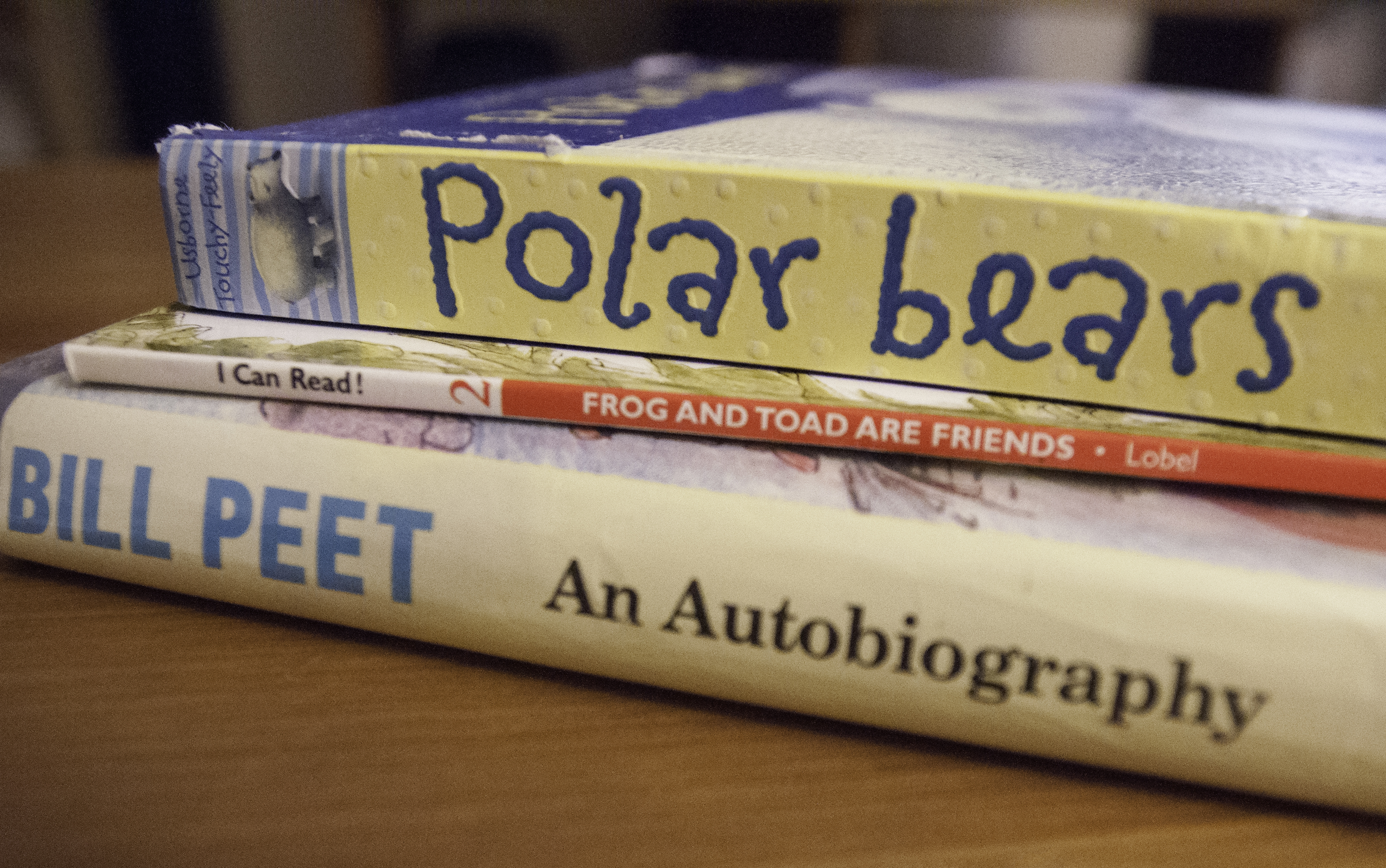
So to mark the occasion of my son’s third birthday, I am posting a picture of his first book (Polar bears), one of his favourite books (Frog and Toad are Friends), and the book we are currently reading (Bill Peet An Autobiography).

Charles books

Happy birthday, sweet boy! Mommy loves you bunches and bunches.

la petite mort sanglante

Standard

To help move along my writing and spark my interest again, I decided to pick up Lucrezia Borgia by John Faunce. This is his debut, and only, novel, though his bio included in the book, published in 2003, indicates that he has written television movies and works as a screenwriter in LA.

I debated about including my thoughts on this novel for re: read pages because no matter what I say, Faunce wrote a book that got published, which I have yet to do, and because I wanted to focus on writing that impressed me with its craft and, as you have probably guessed, this novel does not.

Despite my interest in the Borgia family (they play an important role in my own novel), I have had a difficult time finding a perfectly satisfying read about this notorious clan. The gossip about the potentially incestuous relationships between siblings seems to be too juicy to not play up in one way or another, and too many authors lose their place trying to weave these tidbits into their narratives. Faunce is no different.

Interjections of Greek and Latin meant to showcase Lucrezia as a unique mind instead of just a unique body feel slapped in more to show the author’s knowledge than his character’s. The moments of humour meant to bring levity to more serious situations generally fall flat. I’m also not sure what he intended by turning Cesare Borgia into a temper-tantrum throwing adult, complete with stomping feet and high pitched voice. Is this humour again? Is it meant to show that he is no better than his sister who shed tears in an attempt to avoid her first marriage? It is difficult to reconcile the Cesare of Lucrezia’s admiration and the captain of the Holy Army to this whiny child-man. But the worst offence is the treatment of sexuality.

Lucrezia is meant to be seen as a golden beauty from a very young age. Her value, according to her family, comes from her looks. It is one reason why she can be bartered in marriage three times in her life despite concerns about the trustworthiness of her family. But her sexuality and the role of incest in her family are so poorly executed that Faunce loses any credibility he may have built up with historical detail.

Lucrezia’s second husband, Alphonso, whom she loved, is beaten near to death in front of her eyes and she is nearly murdered herself. But Lucrezia, while surrounded by her attackers and cradling her husband’s head, isn’t overcome by fear and grief but by memories of their lovemaking:

“Remember me.” I called as loudly as I could to Alphonso, though I’m now certain what felt a yell was only a longing whisper. “Remember that even in Heaven no one will ever love you the way I do….Remember me,” I whispered again to my husband. “If you forget my voice, remember my body, the ways it loved you.”

Lucrezia’s odd way of experiencing trauma continues as she cleans Alphonso’s wounds. While washing blood from Alphonso’s body, she imagines Mary Magdalene giving Jesus a blow job. Yep. Nothing like blood on your hands to get you thinking about Jesus and oral sex. But Faunce isn’t finished yet. Alphonso still needs to die. In his final hours, Alphonso, who has been nursed back to life by a fiercely dedicated Lucrezia, makes love to his wife, but their post-coital rest is interrupted by Cesare, who has talked his way past guards at the door. He begs Alphonso’s forgiveness, admitting that he sent the attackers that caused his near death; however, once they are relaxed Cesare turns and attacks Alphonso himself. Lucresia attempts to defend him and is hurt in the act. In Faunce’s telling, this is a total turn-on:

Alphonso and I were naked. More blood kept flowing from my cut hands. An image formed in my mind…In my mind we seemed a strange, desperate ménage a trois. But I confess our threesome was oddly attractive to me, unbidden, nightmare daydream.

Ugh. If this passage hadn’t occurred near the end of the novel, I would have tossed the book aside completely. Faunce teases the reader with incest but never full commits his heroine. In another (more well-written) book about the siblings, Blood and Beauty, author Sarah Dunant puts the incestuous leaning fully on Cesare’s shoulders. While Faunce also hints that Cesare, in a kind of madness, is in love with his sister, passages such as the one above allow Faunce to indulge in sibling love scenes without really dirtying his main character (I won’t even get in to Lucrezia’s pleasure in remembering hearing her parents have sex in the next room).

Overall this book didn’t provide any insight into the Borgia family. It felt like a shallow interpretation dressed up with sex and Latin.

I hope I will do better.

All quoted passages from Faunce, John. Lucrezia Borgia. 2003. Three Rivers Press, New York.

The first cut

Standard

I’m editing my first 50 pages and needed a little perspective:

“The first draft of anything is shit.” Ernest Hemingway

“If a word in the dictionary were misspelled, how would we know?”  Steve Wright

Ah, better. Now back to editing.


For more quotations on editing, check out the blog Terribly Write.

Don’t take my word for it

Standard

Blood Ties by David Adams Richards

Richards’ second novel, Blood Ties, came out in 1976 and is also set in Miramichi Valley, which was introduced in his debut novel, The Coming of Winter. This time the MacDurmot family gives the reader a glimpse at life in small-town New Brunswick, though characters from the previous novel make an appearance as well. Blood Ties takes place during the period from July 1967 to October 1969 (so just before the beginning of The Coming of Winter; see my discussion of that novel here).

The most frequent viewpoint is that of Cathy, a young woman finishing high school, but the story is also told through her family members’ experiences, including her mother and father, Irene and Maufat; her half-sister, Leah; and her brother, Orville, and through some of the other men in and around the MacDurmots’ lives.

The voices of the characters are very strong, and the cadence of the area runs through all their conversations and thoughts. This pattern of speech does more than localize the speakers. It reflects where they are and where they are expected to go in their lives.

There is a lot of repetition in this novel; the characters repeat the same phrase in a single conversation and they have the same conversation over and over. This repetition leaves the impression that the characters are stuck – verbally and developmentally. They think and speak more than they act, as if the forming of words could take the place of action.

Near the beginning of the novel, Leah complains about her husband, Cecil. He is a drunk and abusive, and she has come to her parents’ home after Cecil has thrown their young son against the stove. It is clear that Leah has been there before for the same reason. After venting to her family, Leah makes to return home but her family prevents her, not because of what Cecil did, but because of the hour. Leah claims that if Ronnie wasn’t around she would have left Cecil already, but her words are empty and no one responds “because everything was said and they couldn’t say anymore.” Talking is Leah’s only action and no real change is expected to occur.

The next day, Maufat returns with Leah and Ronnie to their home with plans to set Cecil straight, but after Maufat asks why he roughed up Ronnie, he leaves without confronting Cecil directly:

He hadn’t said it, not said it at all. He turned and started out the door….He went out from the stale heat of the house into the bright of the day, the burning of it. “Shit,” he kept thinking. “Shit.” He went out the gate and began walking up the highway, the grasshoppers stiff and silent and deadened in the heat. He kept thumbing cars that passed him as he walked. “Shit,” he kept thinking. “Shit.”

So Leah and Ronnie stay with Cecil, and Maufat goes to work like any other day, which, for them, of course, it is. The fighting, even the violence, between Leah and Cecil is accepted as just being part of their relationship and, more generally, anticipated from men in their town.

Cathy, experiencing her first real relationship with John, the same character from The Coming of Winter, follows the pattern set by her half-sister. She ignores or explains away John’s negative behaviour. He calls Cathy names, makes fun of her in front of other people, refuses to come into her home, doesn’t call when he says he will, talks about his ex, and, on their first date, pressures her in to jumping a fence rather than paying to enter a fair. Yet, Cathy keeps dating him despite knowing she wants better:

She felt desperate and angry with herself, and yet she clung to his arm. When she clung to his arm he moved to open the door and she said: ‘No, don’t go,’ and he turned back to her rubbed his dark hand across his black hair and straightened.

John’s behaviour isn’t unexpected. If Cathy stays in this town, it goes without saying that men like John and Cecil will be part of her romantic future. But Richards provides hope alongside the struggle. Cathy, after a shocking revelation from John, decides to head west with a friend, and Leah, after her own particularly painful encounter with Cecil, works up the courage to leave as well. But more than that, Richards provides an example of a dependable man who remains in the town.

Near the end of the novel, Richards includes a beautiful flashback to the early days of Irene and Maufat’s relationship as they go on a walk together. It is almost dreamlike in its telling, hazy with summer heat; the thickness of the memory makes his behaviour seem like a mirage, but the real love Maufat offers Irene is clear. He, among so many poor romantic examples, is trustworthy and supportive and Irene bares herself to him literally and figuratively.

Richards then proves this mirage to be reality using a bit more repetition. Throughout the book the MacDurmot family hitches rides in cars and even school buses to get around town. Maufat keeps saying he will have to get a car, but by the end of the novel the reader is conditioned to expect that he will do nothing more than talk getting a car. Except, then he does.

He stood and went to the fridge again and she looked out the window. Then he brought the beer over and went to open it, but she [Irene] threw her arms around his neck and at first she was laughing and then she was crying, feeling herself sink against him. He put his arms around her. She was shaking and crying.

“Told ya I’d get a fuckin car, didn’t I – told ya I’d get a car, didn’t I?”

The verbal repetition continues but this time it is accompanied by action, the buying of the car. Furthermore, Maufat promises to help Cathy and her friend leave town by upgrading their train tickets. After Maufat follows through about the car, the reader is left feeling hopeful for the MacDurmots and, more generally, for the characters in the town.

All quoted passages from Richards, David Adams. Blood Ties. 1992 McClelland & Stewart Inc., Toronto