Get on with it

Standard

Sometimes you just want to feel like you are accomplishing something and moving forward with your goals. With that in mind, I have decided to submit my novel to a publishing house that is accepting unagented authors in the month of June. I’m going in with no expectations; I just want a real deadline and a purpose to my progress.


So the month of May will be all about cleaning up my first 50 pages. I’ve been a little terrified about rereading my own pages. The impulse to delete everything because it is not good enough will be difficult to suppress, but this is where the hard work of writing comes in. Deny the doubt and get on with it.


That means I will be editing and reworking 14,400 words – too much of it dialogue. Since I’ve started this blog, I’ve noticed that the fiction I admire generally has very little dialogue. While I can’t completely change my style, it is a little chatty, like me in real life, I can work on being more selective with what needs to be said or at least present the same information in a less direct way.


I will also have to answer questions that I’ve put off answering in order to avoid more research, such as the size of personal libraries in late 15th century Italy (FYI, Google and Wikipedia are no help).


And I will have to decide where to begin. I’ve already changed the beginning twice. I’m not sure if I’ll keep the beginning I have right now, which is an extended flashback (admittedly another crutch in my writing), or rework the back story to be revealed as part of Rosaline’s character development.


The first step will be printing those pages out, grabbing a green pen (it stands out and isn’t as angry looking as red ink) and marking up my work. There is a different feel to editing in hard copy. I can see more when I have all the pages out in front of me rather than scrolling page by page on a screen. Call it old school, but it works. That is this weekend’s homework. Then I’ll set about putting my story back together again.


Now that I’ve started talking about it, I’m feeling more and more excited. Be sure to check back throughout the week and keep me honest!


BJL


84 days

Standard

The last time I posted on this blog was in January. 84 days ago. It feels like forever but, despite my best intentions, I never had the time to put up a proper blog post. Instead, you would have been treated to the incoherent ramblings of a sleep-deprived proofreader whose work was tied to the corporate tax season. The timeframe is, mercifully, defined by law, but the hours are coo coo bananas.

Over those 84 days, I maintained my sanity by reading on the subway. I managed to read three books in 45-minute increments: Lucrezia Borgia by John Faunce, Salt Sugar Fat: How the Food Giants Hooked Us by Michael Moss (I actually read non-fiction!), and One Hundred Years of Solitude by Gabriel García Márquez (third time is a charm). Plus, on my first real night off, I binge read Listen to the Squawking Chicken by Elaine Lui (a memoir, sort of, and great read to celebrate the return of free time). I’ll be posting my thoughts on the two novels over the next couple of Mondays.

My own writing was completely dropped. Terrible, I know. I did try to write while on my way to work, but more often than I should perhaps admit, my thinking between sentences turned into napping for the rest of my commute. But now that my work has slowed and I have more hours to myself, I am ready to rededicate myself to my novel, this blog, and reading.

To help get back into the habit, I am making myself a new goal: 84 days of writing. Every day from today until July 16, which, coincidently, is my wedding anniversary, I will write for at least 45 minutes. I will treat this time like the time spent on my commute – completely unavoidable – and, hopefully, at the end of it, I will feel more invigorated and inspired than I did at the end of tax season. Seems doable!

And just as a little motivational reminder, check out this post from the blog 101 Books on 7 myths about being a writer.

BJL

High/Low reading and it is all good

Standard

I arrange my books by alphabetically by author, and I track them all on an excel spreadsheet. What? There are a lot of them. I used to have more books, but several moves and two children forced me to cull our library in order to save my back and make space. I borrow most of my books from the library anyway, so it didn’t hurt as much as I thought it might when I started the process.

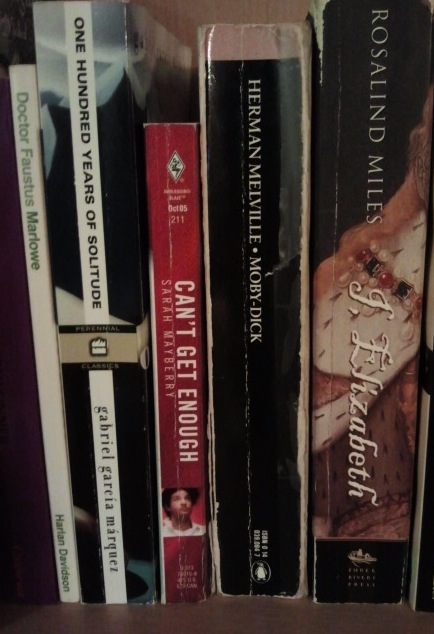
The results of our book purge made me laugh though, as the range my reading habits were made starkly obvious. If you check out the picture below, you’ll see Can’t Get Enough by Sarah Mayberry tucked between the covers of One Hundred Years of Solitude by Gabriel García Márquez and Herman Melville’s Moby-Dick.

SAMSUNG

Ha! What is more hilarious to me is that I will admit that I have never been able to make it through One Hundred Years and have never read Moby-Dick (unless you count the board book version we bought for our infant) but really can’t get enough of Mayberry’s contribution to the romance genre.

Of course, the fact that I haven’t read them is the reason why they are still on our shelf. Perhaps, I should give One Hundred Years another shot and put it on the list for this blog.

How do your shelves stack up? Any amusing literary companions?

BJL

J.K. Rowling is awesome

Standard

It is time for me to come clean. I love the Harry Potter series. Love the books, love the movies. For me, the fact that J.K. Rowling is awesome is not to be disputed. I know there are flaws and I know you probably will want to argue with me, but you will never change my mind.

The little things Rowling puts in the text are just the best, which makes the Harry Potter series worth more than one reread. Here is a good example that just came to my attention thanks to @ArryPottah on Twitter:

The first time Snape speaks to Harry, he says, “Potter! What would I get if I added powdered root of asphodel to an infusion of wormwood?”.

During the Victorian era, each flower type had a specific meaning when a flower was given. Asphodel is a member of the lily family and to give some an asphodel meant “My regrets will follow you to the grave”. Wormwood meant “absence; bitter sorrow”. Thus, Rowling was actually having Snape say to Harry “I bitterly regret Lily’s death.”

While the meaning of asphodel, I believe, is a little stretched to fit the situation (as far as I know asphodel simply symbolizes regret), the statement does still have a deeper meaning to the character. It seems so simple but I think details like that add so much to a story.


My words

Standard

I reread my notes from my novel. Wow, there is a lot of information there – clothing styles, political alliances, modes of transportation, religious expectations, phases of the moon and more and more. And still I have blank spaces in my story. I am beginning to feel bogged down by research and frustrated by my lack of writing, familiar feelings, unfortunately. So I am going to set aside the research for a while, be okay with the blank spaces and star putting words on the page. They may not be perfect words but at least I won’t have a blank white page.

Next week, I will discuss my progress. My goal is seven new pages (no editing previously written ones). For now, I think I need to get up the courage to share some of what I have written already. So I am including a selection from a defining moment in Rosaline’s life. Let me know what you think in the comments!


Catalina’s scream cut the air. Rosaline’s attention snapped back to the shoreline just in time to see her sister being pulled down the river. Rosaline rushed to the water, flinging herself in the current and letting it drag her through the water.  The little girl’s head bobbed in the water ahead of her. Rosaline’s limbs, cold from her first crossing, felt as though they were weighing her down rather than propelling her forward. Rosaline kept swimming, watching for her sister’s flailing arms and calling her name. The river narrowed and the current increased in speed. Rocks jutted out of the water. Rosaline could no longer see or hear her sister. She was battered against the stones. Her head slipped beneath the water. She broke to the surface for a moment before being pulled under again. Rosaline pushed against a rock toward what she hoped was the surface. She gasped for breath as she came up into the air; Rosaline pulled herself from the river and collapsed.

Rosaline’s arm throbbed, a painful assurance that she was still alive. She slowly opened her eyes. She was in her own room, the curtains drawn, a candle flickering on the side table. She tried to lift her head.
“Shhh, you must not try to move, though I am relieved to see you awake,” Maria appeared beside her bed, checking her covers, pressing a cool cloth against her head. Rosaline shifted her gaze to Maria’s worried face. She tried to speak her sister’s name but only a thin whisper past her lips.
“Have a drink.” The cool liquid soothed her throat as she drank, but even that small act depleted her strength.
“Catalina.”
“Rest,” Maria said, tucking the blankets around Rosaline. Rosaline’s head began to throb like her arm. Did they not know that Catalina was missing? Where was her sister? White flashed before her eyes. The rush of the water sounded in her ears and then all was black once more.

The sun was shining on her bed the next time Rosaline opened her eyes. Her arm and head no longer hurt, so she propped herself up.
“You’re awake.” Her mother’s voice drew her eyes to the window. Alma’s dark silhouette turned; Rosaline could not see her face.
“Where is—”
“Do not speak,” Alma sharply cut off Rosaline’s question. “You have been sleeping for five days. How could you let her near the water? How could you let her fall in?”
“I tried—”
“I told you not to speak!” Alma rushed to the bedside, “We found her not 15 feet from where you lay. Her face blue. Her leg twisted. Her hands bloody and torn.” Alma’s face, now close to Rosaline’s, was pale. Her eyes were red and puffy. “You were supposed to protect her,” Alma said, pushing away from the bed and walking toward the door.
“Mama.”
Alma froze. Without looking back she replied, “I only had one daughter, and I buried her yesterday.” Alma stepped from the room, closing the door on the anguished cries coming from inside

This one is for you

Standard

I was warned by a lot of well-meaning people to do things (travel, watch movies, sleep) before I had kids because after they were born I wouldn’t be able to do them anymore. So the idea of being a writer would have to be abandoned in order to provide for my family in a more realistic way.

Well, now I have two kids, but instead of feeling like I have to give up my goal of being a published author, I think I’ve gained two more reasons to keep trying. How can I tell my kids to pursue their dreams if I give up on my own?

Which is an overly serious way of bringing up the topic of dedications. Many dedications are to family members or close friends (I know I’ll mention mine when I get the chance), but some authors are a little more creative.

I recently found this dedication from Rick Riordan’s House of Hades, which was published in October, 2013, while clicking around BuzzFeed.

To my wonderful readers:
Sorry about that last cliff-hanger.
Well, no, not really. HAHAHAHA.
But seriously, I love you guys.

How awesome is that?

A Christmas Carol by Charles Dickens

Standard

Over the holidays I decided to read a classic novel and A Christmas Carol just seemed like the perfect choice given the time of year. I haven’t read this novel in over a year and it was a pleasure to read again. It is such a quick read, so I fit it in between festivities, travel and power outages.

I’ve mentioned before that one of the reasons I enjoy rereading books is because they give you something new each time you read it, and my belief holds true for A Christmas Carol. I went in to the book planning on blogging about why it is such a classic tale, but instead I was struck by Scrooge’s boldness when initially confronted by the spirits.

When Scrooge is first confronted with Marley’s ghost, he behaves in an aggressive manner. Having seen his late partner’s face in the door knocker, Scrooge enters his home, checks all the corners of his room and double-locks the doors and once Marley makes his appearance Scrooge speaks first, “‘How now!’ said Scrooge, caustic and cold as ever. ‘What do you want with me?’” After the ghost identifies himself, Scrooge even invites him to sit down. Scrooge doesn’t become frightened until the ghost removes some bandages from his face, revealing a disfigured jaw, and rattles his chains. But even after Marley explains that three spirits will visit Scrooge in an attempt to avoid the purgatory that he suffers, Scrooge offers a cheeky reply:

“Is that the chance and hope you mentioned, Jacob?” he demanded in a faltering voice.
“It is.”
“I–I think I’d rather not,” said Scrooge.
“Without their visits,” said the Ghost, “you cannot hope to shun the path I tread. Expect the first tomorrow when the bell tolls One.”
“Couldn’t I take ‘em all at once, and have it over, Jacob?” hinted Scrooge.

Ha. Seriously, imagine being confronted by a creepy ghost and giving attitude. He greets the first spirit as directly as he did Marley, “‘Are you the Spirit, sir, whose coming was foretold to me?’ asked Scrooge.” It is only once the spirit begins to show Scrooge is past that the old miser’s attitude begins to change, though not his personality. He still wants to try to control the situation. Scrooge is troubled by the sights of Christmases past – his boyhood, a broken engagement, his former fiancée’s new life – but after demanding the spirit release him, he forcibly removes the spirit by extinguishing the light shining from the crown of the spirit’s head.

Trying to regain a stronger position for the arrival of the second spirit, Scrooge pulls back the curtains of his bed so that he can see when the spirit arrives, “For he wished to challenge the Spirit on the moment of its appearance, and did not wish to be taken by surprise and made nervous.” When the Ghost of Christmas Present does arrive, in another room, Scrooge goes to search the spirit out. And, once meeting the spirit, he asks the spirit to teach him his next lesson. The lesson includes the most well-known section of A Christmas Carol, Scrooge’s observation of the Cratchits, his clerk’s family, including their ill son, Tiny Tim.

Unlike the end of his night with the first spirit, Scrooge is given no time to prepare or recover from his experience with the Ghost of Christmas Present. Instead, after the spirit disappears at midnight, he is immediately joined by a hooded phantom, the Ghost of Christmas Yet to Come. Keeping with his previous encounters, Scrooge addresses the spirit directly and, despite his fear, encourages the spirit to fulfill its purpose:

“Ghost of the Future!” he exclaimed, “I fear you more than any spectre I have seen. But as I know your purpose is to do me good, and as I hope to live to be another man from what I was, I am prepared to bear your company, and do it with a thankful heart.”

With this spirit, the one he fears most, Scrooge is most eager to accompany, “‘Lead on!’ said Scrooge. ‘Lead on! The night is waning fast, and it is precious time to me, I know. Lead on, Spirit!’” In this experience, Scrooge learns the sad fate of Tiny Tim and of his own unmourned death. He begs the Ghost of Christmas Yet to Come to allow his future to be changed. As with the first spirit, Scrooge reaches out to the Ghost, but instead of trying to rid himself of the spirit, Scrooge is clinging to it, “In his agony he caught the spectral hand. It sought to free itself, but he was strong in his entreaty, and detained it.” While the spirit does pull away and disappear, Scrooge is successful in getting his second chance and wakes on Christmas Day a changed man.

By the end of the book, I saw that it wasn’t Scrooge’s personality that had changed but his attitude. He started to take as much pleasure in Christmas and life as he use to waste in anger and hardness before the spirits’ visits. His change of heart is a source of amusement for some, but, as he didn’t care when people hated him for his coldness, he doesn’t care if they find his new attitude strange.

All quoted passages are from Dickens, Charles. A Christmas Carol. London: Chancellor Press, 1987.

Month One

Aside

So, December is not the month I recommend you start a blog. Whoa. Between illness and the holidays, I kinda drop the book for this blog, as it were. Don’t get me wrong, I am happy that I started re: read pages and I am looking forward to writing some more, but, not unlike the writing of my book, I underestimated the effort involved in maintaining a good blog.

Thank goodness for new years and fresh starts.

Welcome back, dear Readers, and Happy New Year!

Looking at how my first month went, I am going to revise the blogging schedule. Mondays will still be book discussion, but, for the time being, I am dropping it down to a bi-weekly update, with maybe a little commentary as I read to help keep the habit up.

So, please enjoy my take on a classic novel, A Christmas Carol, which you’ll find in the next post, and we’ll start fresh for 2014.

Christmas break

Aside

I originally planned on keeping up the blog over Christmas week but now that it is upon us, I realize that I won’t be able to give re: read pages the attention it deserves and spend time celebrating the holidays.

So please come back on Monday, 30 December for re: read pages’ regular schedule and have a safe and happy holidays!

Going forward

Standard

This week, I reread the pages I have completed so far on my novel. There were good parts and bad. In some places I just wrote in what I needed to find, for example “job title,” or “Transition” when I wanted to get to the next scene. I can see what I’m trying to do and still like the idea but it is so rough. So, so rough.

My biggest desire is to go back and smooth it out, work out the kinks and fill in the blanks but I am going to ignore that impulse. It can be fixed later. Right now I need to get more words on the page.

So I have made two goals for myself. First, I want to reach the end of my novel. I figure it should be a little over 300 pages when I am finished. If I even wrote just a page a day, I could be done before the end of 2014. I know that a page a day is an impractical way of writing because I won’t get the chance to write every day, but a goal of seven pages per week (minimum) doesn’t seem that impossible.

Second, I noticed a dependence on dialogue. I use it too much and skip over showing the scene. I need to start filling in those blanks, show what the character is seeing and add some heft to the scenes. I think this will go a long way in adding not only length but quality to the pages.

When I think of the books I admire, there is not very much dialogue. Part of reading great books is the hope that their greatness will sink in and influence my own writing. I’m hoping that the idea behind “you are what you eat” converts to “you write what you read,” kind of like I’m consuming nutritious novels instead of sugary beach reads. I like sugar and there is noting wrong with eating a little, but I have to eat my Grapes of Wrath, too.

I must admit, it was a little discouraging to go back and look at my old work. I remember being excited when I wrote it and going back to it with a cold read exposed its flaws. I know that there will be a lot of revision and ultimately it will make the novel better, but right now it feels like a long way between the first word and last word. So I am trying to focus on a quote from Earl Nightingale:

Don’t let the fear of the time it will take to accomplish something stand in the way of your doing it. The time will pass anyway; we might just as well put that passing time to the best possible use.

Writing a book seems like a good way to pass the time.